King of the Court Rules & Ladder


King of the Court is the format for a group that meets every week and wants the wins to mean something beyond tonight. It's a ladder: play well and you climb toward the Challenge court, slip and you slide back, and where you land carries into next week. This guide explains the rules, the three-tier ladder, and how to set it up — and clears up the single most common mix-up about it.
First, the thing everyone gets wrong
King of the Court is a session format, not a tournament type. You don't build it in the tournament creator — you pick it in the game format picker, the same place you'd pick Popcorn or Shuffle, and run it as a recurring weekly game. Inside Pikel there's a built-in explainer screen that walks your players through the ladder the first time they see it.
What King of the Court is
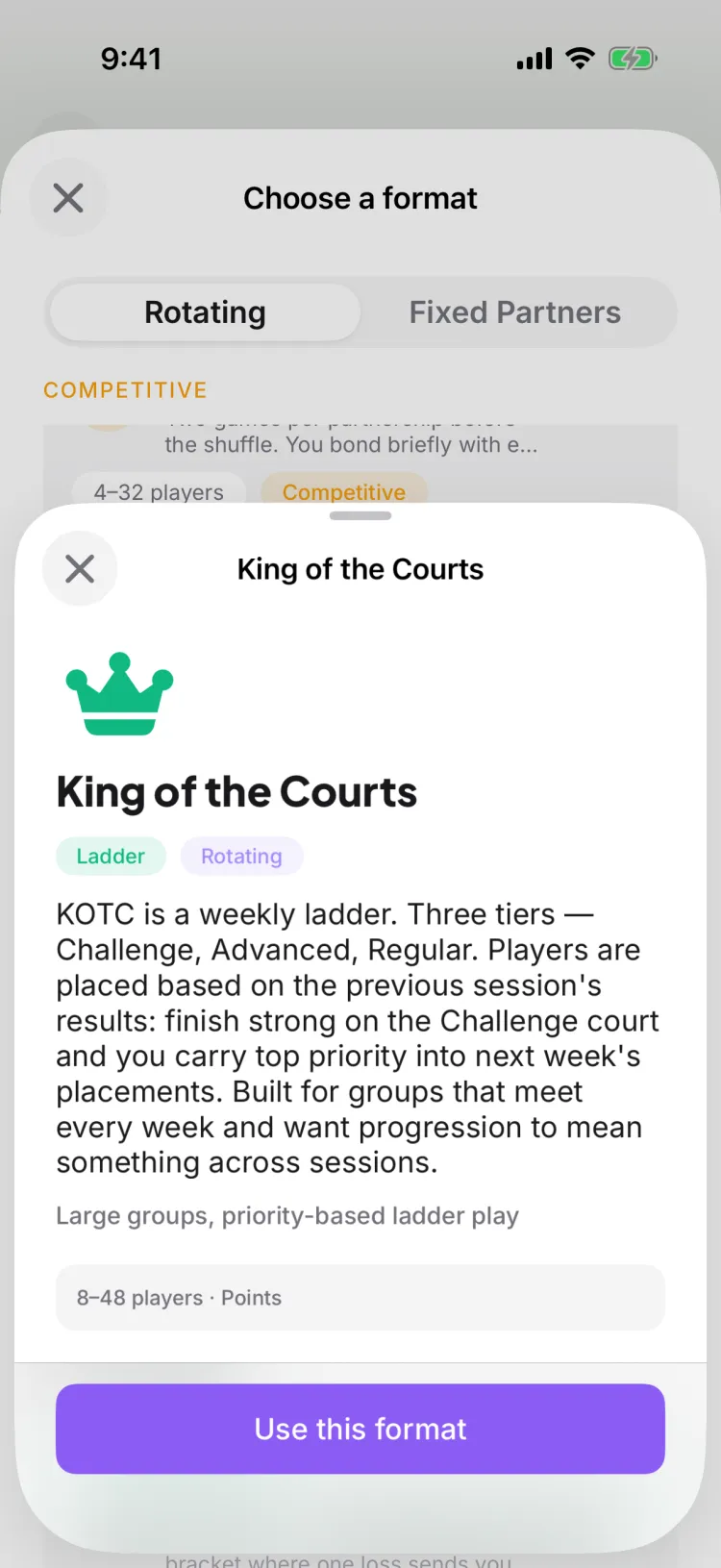
King of the Court is a weekly ladder. Three tiers — Challenge, Advanced, Regular. Players are placed based on the previous session's results: finish strong on the Challenge court and you carry top priority into next week's placements. Built for groups that meet every week and want progression to mean something across sessions.
Three things define it:
- Tiered Bracket — a 3-tier bracket: Challenge, Advanced, Regular. Court 1 is the challenge court.
- Recurring Sessions — designed for weekly play. Each session's results seed the next.
- Priority Carryover — last week's Challenge-court finishers seed at the top of next week's bracket.
When King of the Court fits
This is the format for a standing weekly group — the crew that shows up every Tuesday and wants a reason to keep showing up. It works best with 8 to 48 players and a wide-enough spread of ability that the three tiers actually mean something. If your group is a one-off or a rotating cast of strangers, you'll get more out of Popcorn; the carryover — the part that makes King of the Court special — needs a group that comes back.
Step 1 — Create it as a recurring series
Tap the plus (➕) button, choose Round Robin, and set up the game as a recurring series (weekly is the natural cadence for King of the Court). The recurring schedule is what lets one week's results carry into the next — without it, there's nothing to carry over.
Step 2 — Pick the King of the Court format
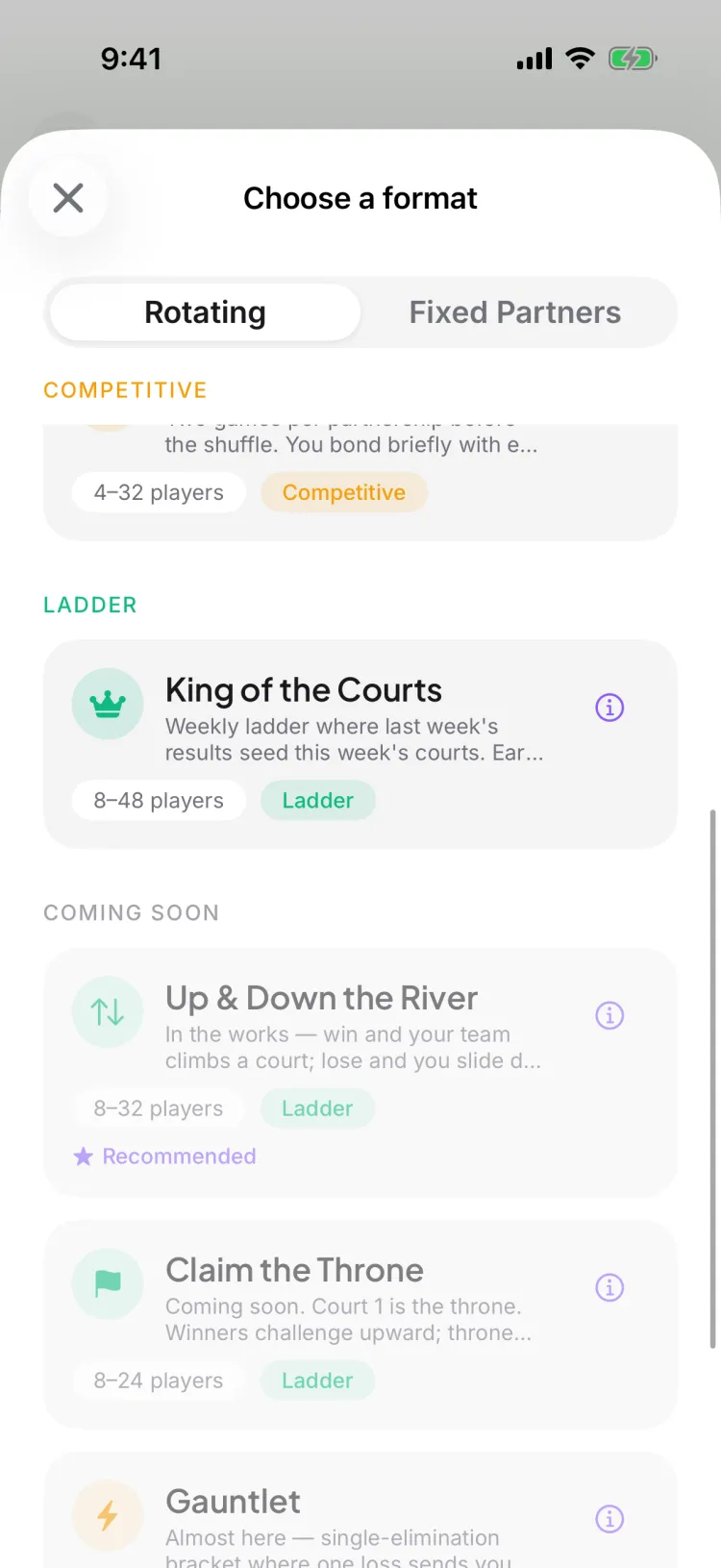
Open the format picker and select King of the Court (it appears in the picker as "King of the Courts"). It's built for 8 to 48 players, so set a player cap and a waitlist that match your court count and the group you draw each week.
Step 3 — Seed the first session
On the very first session, set the placements yourself — there's no prior result to seed from, so this is the one week you're doing it by hand. After that, carryover takes the wheel: each week's Challenge-court finishers seed at the top of the next.
Step 4 — Run the night and let the ladder move
Play the session like any game night — generate rounds, enter scores courtside, and watch the standings. As results land, the tiers sort: strong finishers earn their way toward the Challenge court, and the next session's placements are set from how tonight ended.
Pro tip
Seed placement matters most the first session — fill in manually if the group is new, then let carryover take over.
Get started
Pikel is live on iOS and Android. Set up a recurring game and run King of the Court.
- iOS: https://apps.apple.com/app/pikel/id6760790860
- Android: https://play.google.com/store/apps/details?id=com.plyvo.pikel
See you on court.
Frequently asked questions
Is King of the Court a tournament?
No — it's a session format, not a tournament type. You run it as a recurring weekly game night, and each session's results seed the next. It lives alongside Popcorn and Shuffle in the format picker, not in the tournament builder.
How does the ladder carry over week to week?
King of the Court has three tiers — Challenge, Advanced, and Regular. Where you finish this week sets where you're placed next week. Finish strong on the Challenge court and you carry top priority into the next session's placements.
How many players do I need?
King of the Court is built for 8 to 48 players. It shines with a steady group that meets every week — the carryover is the whole point, so a one-off night doesn't get the payoff.
What if my group is brand new and has no history?
Seed the first session yourself. Placement matters most on week one because there's no prior result to carry over — set it manually, then let carryover take over from week two on.
Which court is the top court?
Court 1 is the Challenge court — the one everyone's trying to reach and hold. The three-tier bracket runs Challenge, Advanced, and Regular from the top down.